




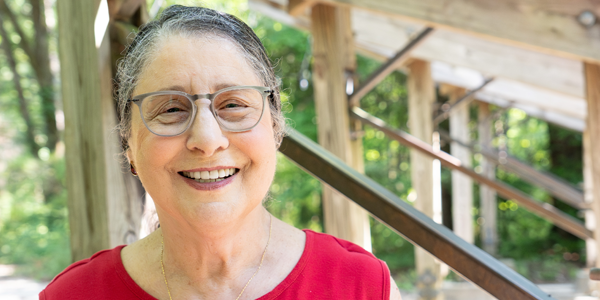
Emily Kling '03
At 6 years old, Emily Kling caught the nature bug. Her hikes with her grandfather were her gateway to the natural world when she was growing up in Huntsville in the 1950s.
"There's a picture that my grandmother took on the hottest day of the year," Kling said. "My grandfather is shirtless with a bandana around his head. Well, there's little Emily right next to him, shirtless with a bandana around her head. I have the most wonderful memories of those hikes with my grandfather."
Those experiences helped shape her lifelong love of nature and eventually her career. Kling spent more than 30 years working with 4-H and Cooperative Extension as a county agent and state specialist in Kansas and Alabama, as well as a national project leader in Washington, D.C., before retiring from Auburn University with the Alabama Cooperative Extension System in 2010.
Now, she is a trusted volunteer with Auburn's 120-acre Kreher Preserve and Nature Center (KPNC) and a major philanthropic partner helping to make the outdoors more accessible to a new generation of nature lovers.
"I think the KPNC can help create memories like I have hiking with my grandfather," Kling said. "We want people and families to come out here and go hiking and participate in educational programs. We're trying to develop a population in the Auburn area that appreciates the natural environment and wants to preserve what we have."
A career in the natural world
After studying field biology at Principia College, a private liberal arts college in Illinois, Kling decided to further her education at the University of Michigan with a master's degree in environmental education instruction, graduating in 1979.
It was then that she got her first big job — and broke a glass ceiling in the process.
When Kling joined the Kansas Cooperative Extension Service, she became the first female 4-H Natural Resources Specialist in the United States.
After 12 years as an environmental educator in Kansas, Kling was offered a two-year assignment to help develop the national 4-H Environmental Stewardship program. After that, she decided to head home to Alabama and jumped at the opportunity to become an environmental agent in Baldwin County, where she worked primarily in water quality education.
In 1997, she transferred to Auburn University to work with the Alabama Extension 4-H program and took charge of programming statewide, including for forestry, wildlife management and environmental issues. Working at Auburn also allowed her to go back to school, where she earned a doctorate in higher education administration and became the only Auburn graduate in a family full of Alabama alums.
After retiring from Auburn, Kling spent the next 10 years working as a Camp Mom and staff leadership trainer at a summer camp in North Georgia, until the COVID-19 pandemic ended that in 2020.
Finding a niche at the KPNC
After moving back to Auburn, Kling got plugged back in with volunteer work at the KPNC, where she previously volunteered and has been a longtime board member. Kling does a little bit of everything, from maintaining bird feeders to keeping storage rooms organized and helping with events.
She recently took her support of the KPNC to a new level with a substantial gift in support of the new Environmental Education Building.
Kling's gift was honored with the naming of the Emily Kling Discovery Corridor, a walkway where visitors can see the KPNC's amphibians and reptiles, in addition to a variety of interpretive and engaging environmental education displays.
For Kling, it made sense to support a cause so near to her heart by using a tax-advantaged Qualified Charitable Distribution (QCD) from her IRA. Because she was required to pull funds out of her IRA, her QCD allowed her to make a gift to the KPNC while avoiding an unnecessary tax bill.
"The QCD method made it very easy to transfer some stock to the Auburn University Foundation," Kling said.
Through her philanthropy and loyal service to the KPNC, she hopes today's generation of children will make memories with their parents and grandparents, much like she did when she was young. And most of all, she wants people to experience the calm and sense of joy that the natural world can provide.
"I just like coming out here, and I want other people to enjoy what I get to enjoy," Kling said.
For more information about making a planned gift, contact [email protected] or 334-844-7375.